Material culture · Scent science · The language of perfume
Does Silk Have a Scent?When Softness Becomes the Language of Perfume
We recognise silk by the way light moves across its surface and the way a fabric falls against the hand. But when a fragrance lists “silk” among its notes, are we smelling a fibre — or describing a sensation our nose cannot quite name?
Prepared from an editorial manuscript and brand information supplied by ZCONY.
There is a word shared by fabric shops and perfumeries: soft.
When we run our fingers over silk, we might call it smooth, fluid or light. Then, unexpectedly, we use the same words for a perfume. Our nose has not touched any fabric; our hand has not handled an aroma. And yet the comparison can feel entirely natural.
It is a better question than simply asking whether silk smells pleasant. It leads us into a world of physical materials, the human decisions behind craft, and the way our senses borrow vocabulary from one another.
Before the fabric, the fibre
Long before silk becomes a scarf, a blouse or a moving band of light, it begins as a filament. The silk used for many textiles is produced by the domesticated silkworm, Bombyx mori, as it constructs a cocoon. Two key proteins help make up that material: fibroin, which forms the structural filament, and sericin, which surrounds and binds fibres in the raw state [1].
Textile preparation may include degumming — the removal of some sericin to obtain particular material properties. Reeling, preparation, dyeing, weaving and later care all contribute to the experience of a finished piece of cloth [1].
This matters when someone asks about “the smell of silk.” Raw fibre, processed thread, dyed cloth and a garment stored with other belongings are not identical environments. It would be misleading to say that every piece must carry one universally recognisable scent. What we smell on a fabric can also be affected by dyes, treatments, storage conditions or products it has come into contact with. That is not, by itself, evidence of an intrinsic signature aroma belonging to silk protein.
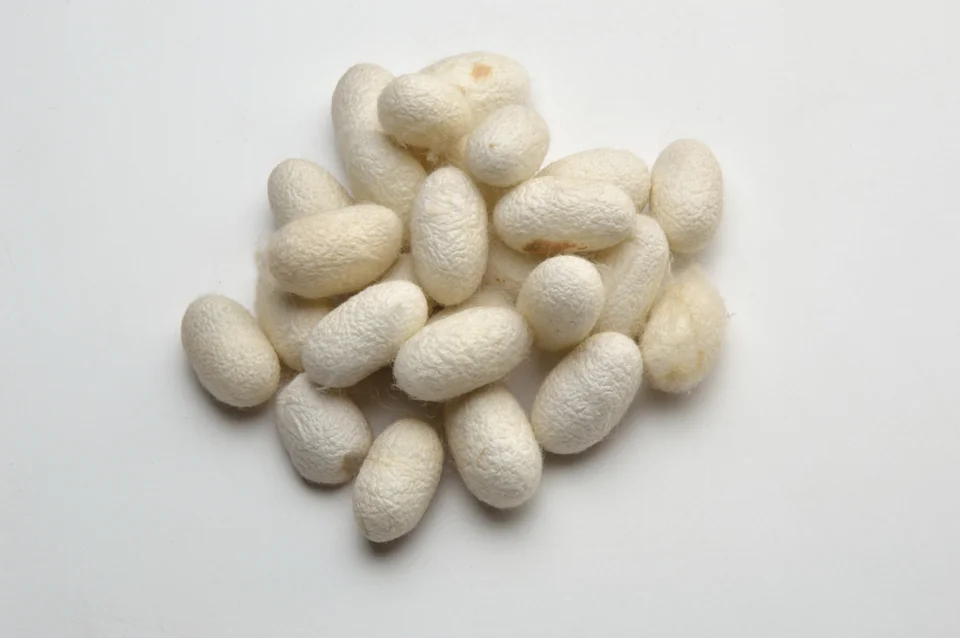
The beauty of silk is more than sheen
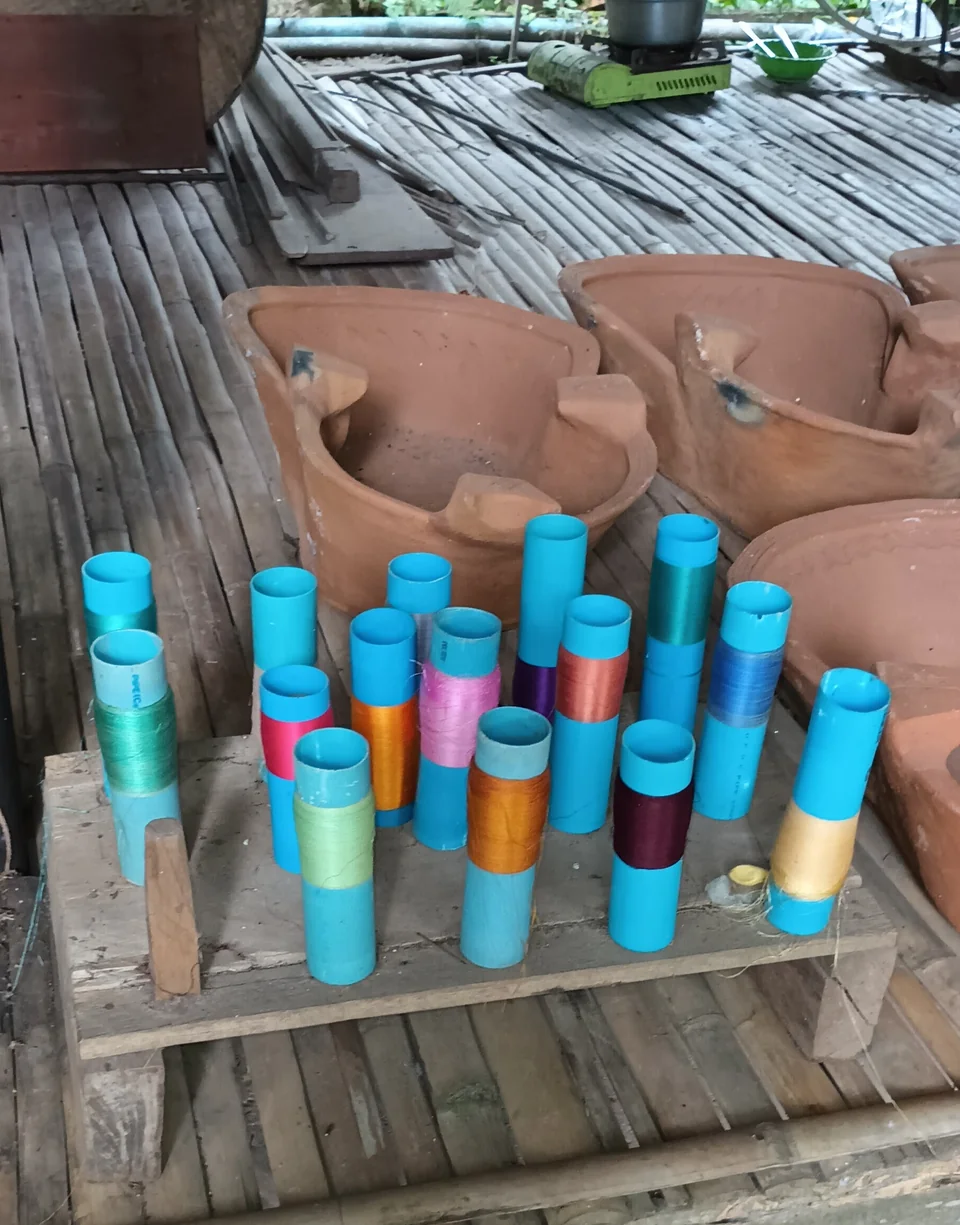
Thai silk offers a particularly rich way to think about the subject. A textile is not only a laboratory material. Its appearance can depend on the decisions of a weaver: how threads are arranged, where a pattern changes, and how colour enters the finished surface.
A UNESCO case study on natural dyeing and silk weaving in Surin, northeastern Thailand, describes the intricate matmee or ikat tradition, the meanings cloth can carry within communities, and the many kinds of skilled work involved — from growing mulberry and raising silkworms to preparing a loom [2]. From a distance a woven surface may appear calm and seamless; up close, it holds decisions, labour and regional knowledge.
This is not an argument that all Thai silk is made alike, nor that natural materials are automatically better than synthetic ones. The interesting point is that the softness we perceive may be the outcome of very particular work. It is more specific than a generic claim of luxury.

Can a smell change the way a fabric feels?
Our noses do not measure the smoothness of fibres. But neither do our senses behave like separate, sealed compartments.
In a pair of experiments published in Chemical Senses in 2006, M. Luisa Demattè and colleagues tested interactions between olfactory cues and tactile judgments. Participants' ratings of the softness of fabric swatches changed with accompanying smells. Under the study's conditions, the fabric was rated softer alongside a lemon odour than alongside an animal-like odour [3].
The finding does not mean that lemon perfume physically softened the material, or that every person will respond in the same way. It suggests something more subtle: under experimental conditions, one kind of sensory information can shape a judgment made through another sense.
Research into crossmodal correspondences has also explored how people match odours with other qualities, including musical pitch and geometric shape [4]. Such matches are not necessarily descriptions of a direct physical property. They show how readily the mind builds relationships across sensory domains.
That helps explain why perfume discussions are filled with apparently impossible textures. A scent can be called sharp, round, warm, airy, powdery or smooth. These words describe how an experience is perceived, not a chemical inventory.
What does “silk” mean in a fragrance description?
Perfume notes provide a working language for talking about a fragrance's character and development. They are not necessarily a complete declaration of the substances in a formula.
When a perfume uses the word silk, it may be pointing toward a smooth, quiet, fluid or skin-close impression rather than a literal extract from silk fibre. That is a way of reading an olfactory metaphor, not a universal rule — and certainly not a substitute for evidence about a particular formula.
The next time a scent seems “silky,” try asking what creates that impression for you. Does one stage feel less abrupt than the next? Is the impression airy rather than dense, or gentle rather than angular? Are you using the word to describe intensity, balance, texture, memory — or some combination of them?
There need not be one correct answer. Describing fragrance is partly an exercise in discovering how our own sensory vocabularies work.
A silk note, without a claim of silk extract
For a concrete example of this language, Enzo by ZCONY has a brand-confirmed note structure: Water / Daisy at the top, Silk at the heart, and Musk / Wood / Amber in the base [5].
Here, “silk” is a stated fragrance note, not confirmation that the formula contains silk protein or an extract of silk, and not a claim about any effect on skin.
What makes the description interesting is the movement between kinds of words: a transparent opening, a tactile metaphor in the centre, and an explicitly described base. Those notes offer a lens through which to explore a scent. They do not require every wearer to imagine precisely the same thing.
Where the comparison ends — and begins
Silk is a physical object: it can be woven, touched and examined. Perfume is an experience produced through volatile molecules and the way our sensory systems interpret them. We do not have to pretend that these two things are identical in order to appreciate the connection.
Perhaps that is the real pleasure of fragrance language. We reach for memories of touch because the nose sometimes notices something that ordinary vocabulary cannot capture quickly enough.
So the next time “silk” appears in a perfume's notes, there is another question worth asking beyond does this literally smell like silk?
What sort of touch does this scent bring to mind — and why?
Further reading and sources
[1] Recent Advances in Environmentally Friendly and Green Degumming Processes of Silk for Textile and Non-Textile Applications, Polymers (2022), https://pmc.ncbi.nlm.nih.gov/articles/PMC8876672/ ; PubMed https://pubmed.ncbi.nlm.nih.gov/35215571/
[2] UNESCO Intangible Cultural Heritage — Natural Dyeing and Silk Weaving in Surin Province, Thailand, https://ich.unesco.org/en/individual-case-study-00988?id=00016
[3] Demattè et al., Cross-modal interactions between olfaction and touch, Chemical Senses (2006), DOI 10.1093/chemse/bjj031, https://pubmed.ncbi.nlm.nih.gov/16452454/
[4] Deroy, Crisinel & Spence, Crossmodal correspondences between odors and contingent features: odors, musical notes, and geometrical shapes, Psychonomic Bulletin & Review (2013), DOI 10.3758/s13423-013-0397-0, https://pubmed.ncbi.nlm.nih.gov/23463615/
[5] ZCONY — confirmed Enzo scent notes: Water / Daisy; Silk; Musk / Wood / Amber. Scent-note vocabulary is not ingredient or formula evidence. Official product information